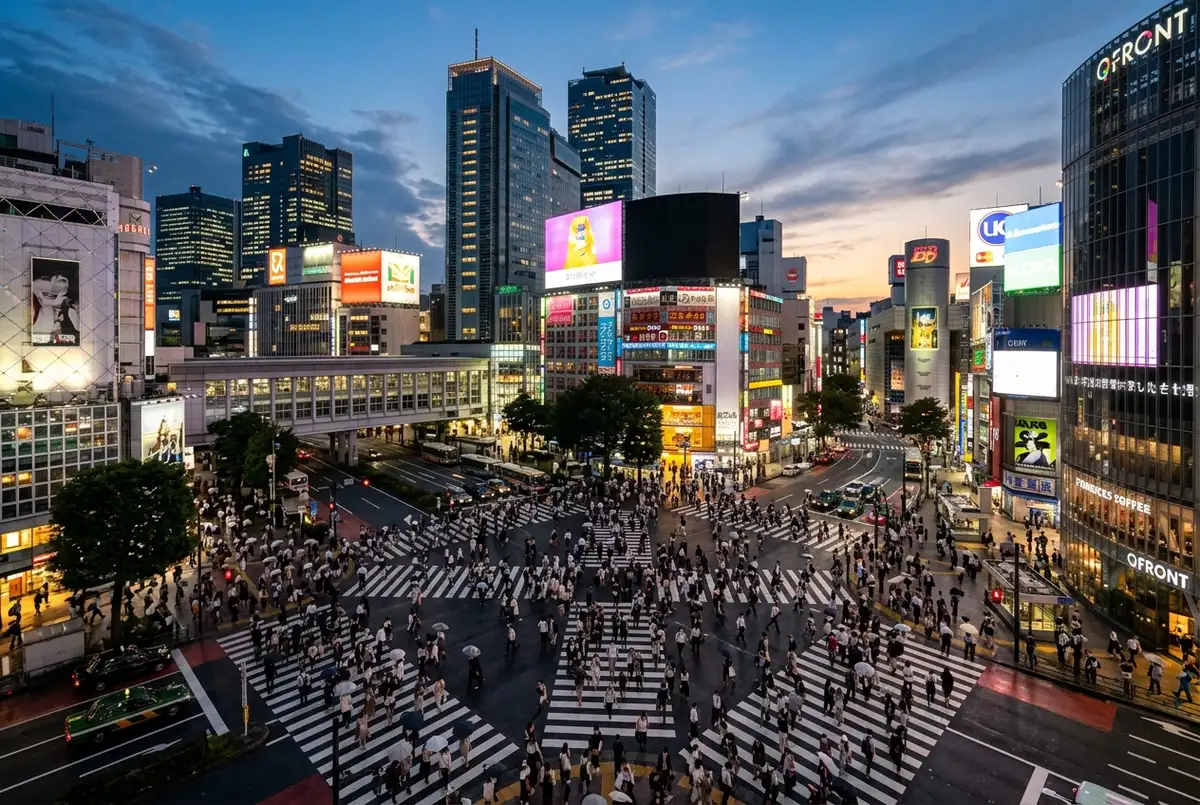
The Shibuya crossing view you pick changes what the famous scramble feels like. From the street you are inside the crowd, from a window you are watching it, and from a rooftop you see the whole pattern of people crossing at once. Here is my honest short answer: start with a few minutes at street level because it is free and it is the real thing, then go up for the top down picture, because that is the one that makes people say “so that is why it is famous”. This guide ranks the vantage points from ground to rooftop, explains what each one gives you and tells you how I’d combine them. If you want the rooftop part planned as a guided route, the Shibuya Sky tours and tickets home page lists every option, and if you are still deciding whether to pay for height, my Shibuya Sky observation deck guide covers how a visit runs.
Price and length are what separate the guided routes that include deck time, so it helps to compare every Shibuya area tour and ticket by price and length.
What Is the Best Place to See Shibuya Crossing?
The best place to see Shibuya Crossing is the open-air rooftop deck at Shibuya Sky, because you look straight down on the whole intersection from about 229 meters. Street level is the best free option, and a window seat in a nearby building is the best middle choice.
I rank the options by what they give you, not by price. The crossing is a moving pattern, so the higher you are, the more clearly you see the pattern. The lower you are, the more you feel the energy. I’d say you need both to understand the place, and that is why I suggest mixing levels.
Here is my ranking, from ground to sky:
| Rank | Vantage point | Cost | What you get |
|---|
| 1 | Open-air rooftop at Shibuya Sky | Paid ticket | The full top down view, sunset and night |
| 2 | Elevated windows in nearby buildings | Free or a drink | A clear angle at a lower height |
| 3 | Station walkways and bridges | Free | A quick raised look, good for a few shots |
| 4 | Street level in the crowd | Free | The feeling of crossing it yourself |
Prices and access rules change, so check the official pages for each place before you go.
Why Does the View from Above Matter?
It matters because the scramble is a pattern, and you can only see a pattern from above. On the ground you see faces and bags, but from a height you see waves of people move in every direction at once and then part around each other.
The crossing works differently from an ordinary intersection. All the signals turn red at the same time, and pedestrians flow from every corner across the road, including diagonally. From a rooftop that looks almost like a slow, living diagram. My take is that photos taken from ground level never explain this, so if you want a picture that shows why the place is famous, you need height. I break down the history and the numbers in what is Shibuya Crossing and why is it famous.
Level 1: The Street View
Street level is free, immediate and worth doing once. You stand at the edge, wait for the light, and then walk across with the crowd. It gives you the sound, the screens and the sense of scale.
I’d spend ten to fifteen minutes here, not an hour. Cross once in each direction, look up at the giant screens and keep your bag close, since the crowd is dense. The mistake I see most often is trying to take a good overview photo at street level, which is impossible because you are inside the picture. Use the street for the feeling, and use a higher spot for the photo.
If you like the idea of walking it with a guide who explains the area, the Shibuya Sky morning tour with ticket walks across the crossing and then goes up to the deck. Prices start from EUR 75 per person as of 2026-09-21 and may vary by date, group size and season. Food, drinks and transport to the meeting point are not included. I’d choose it for a first visit because it covers both levels in about two hours.
Level 2: Station Walkways and Bridges
Raised walkways near the station give you a quick, free look at the crossing from a bit above the crowd. They are good for a few shots, and they are usually easy to reach from the station.
I’d treat these as bonus spots, not a plan. They are often busy with people doing the same thing, and you have to keep moving so others can pass. The angle is better than street level but still low, so you see the crowd rather than the pattern. Access, opening hours and routes near the station change, so look for signs on the day rather than trusting a fixed route. For a longer list of no cost options, see best free places to see Shibuya Crossing.
Level 3: Windows, Cafes and Building Lobbies
Some buildings around the crossing have windows or seating that look down onto it. These are free to enter, but a window seat usually means buying a drink, and the best seats fill up.
My advice is to treat a cafe window as a mid-priced compromise. You pay for a coffee and get a comfortable, sheltered seat with a good, slightly elevated view. The trade-off is that the glass reflects, the windows are not high and your table is not guaranteed. If a spot has a queue, I’d skip it and move on rather than lose your afternoon. Which cafes and lobbies are open changes, so check current details on the day.
Level 4: The Rooftop at Shibuya Sky
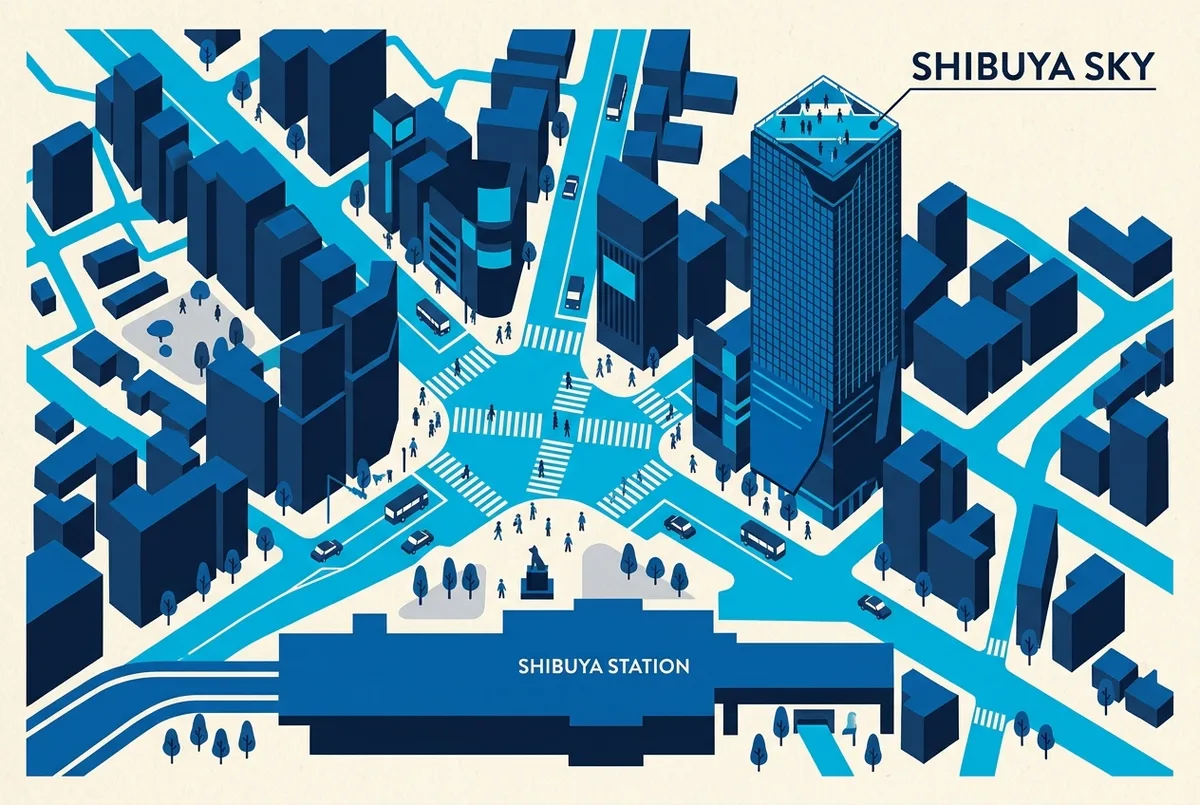
The rooftop at Shibuya Sky is the top down view. It is an open-air deck about 229 meters above the city, on the top of the Shibuya Scramble Square tower, with the crossing directly below and the skyline stretching in every direction.
This is the one I’d pay for. You are outside, there is no glass in front of you and the whole intersection lies below like a map. At sunset the light shifts across the skyline, and at night the neon and the moving crowds create the scene most people picture when they think of Tokyo. On a clear day Mount Fuji can appear on the horizon, but no view is guaranteed. To get the details of how to book, read the Shibuya Sky tickets guide, and to understand the building itself, see Shibuya Scramble Square.
For the official information on the deck, the Shibuya Scramble Square Sky page is the source to trust for current hours and rules.
What Is the Best Time for a Shibuya Crossing View?
The best time is the hour around sunset, because you see the crowd in daylight, then the lights come on. Night is the busiest and most colorful, and early morning is the calmest.
My pick is an arrival about 20 minutes before sunset. You catch the golden light, the blue hour and the first neon, all in one visit. Sunset times change a lot through the year, so check the time for your date. I go through the timing in Shibuya Sky sunset time by month and I cover the after dark scene in Shibuya Crossing at night.
A quick guide to time of day:
- Morning. Calm, clear air, easy photos and the best chance of a long distance view.
- Afternoon. Busy, bright and full of people, good for the crowd pattern.
- Sunset. The best mix of light, and the hardest slot to book.
- Night. Neon, screens and the strongest atmosphere, with reflections on any glass.
Should You Pay for the Top Down View or Stay Free?
Pay if the view is the point of your Tokyo trip, and stay free if you just want to say you crossed it. The paid deck is a real experience, not just a vantage point, and the free options are a genuine and fair alternative for a quick look.
Here is how I’d decide. If it is your first time in Tokyo, you like photos or you are travelling as a couple, I’d pay for the deck and pick sunset or an early night slot. If you are on a tight budget, you have already seen a lot of skyline or you only have an hour, the free options are enough, and I would not feel guilty about it. My rule is simple: if you can only afford one paid view in Tokyo, make it one with the crossing in it. I compare the paid and free decks across the city in best observation decks in Tokyo.
How Do You Plan a Day Around the Crossing?
Start with the street level crossing when you arrive, spend the middle of the day exploring nearby streets and shops, and book your rooftop slot for late afternoon so you land at sunset. That order keeps the best view for the moment the light is best.
I’d book the slot first and plan the day around it, not the other way round. A timed ticket is the part that can sell out, whereas the street and the shops are always available. My suggested shape for a day is:
- Morning: walk across the crossing and see Hachiko.
- Midday: lunch and shopping in the area around the station.
- Afternoon: a slow walk or a coffee near the crossing.
- Late afternoon: check in for your rooftop slot.
- Dusk and evening: stay on the deck, then dinner nearby.
For a full timed version of this plan, my Shibuya one day itinerary puts times against each step, and things to do near Shibuya Sky suggests places to eat and wander before or after.
Is Shibuya Crossing in the Middle of Tokyo?
Shibuya is one of Tokyo’s 23 special wards, on the west side of central Tokyo, and the crossing is right outside Shibuya Station. It is easy to reach by train from most parts of the city, which is one reason it is such a popular first stop.
If you are unsure where it sits on your map, I answer the basic questions in is Shibuya in Tokyo. For the practical route to the deck itself, see how to get to Shibuya Sky.
What Should You Bring for a Good View?
Bring a light layer, a charged phone and a bit of patience. The rooftop is open-air, so wind can be strong even on a mild day, and the crossing at street level is crowded enough that you want free hands.
A few things I’d pack or plan:
- A wrist strap or secure grip. Phones and open-air decks do not mix with loose hands.
- A light jacket. The wind on the deck can be cooler than the streets.
- A spare battery. Night photos and video drain a phone quickly.
- A clean cloth for your lens. Glass and fingerprints ruin more photos than dim light does.
Rules on bags, tripods and lockers can change, so check the official page before you go. My guide to Shibuya Sky photos goes into camera settings and where to stand.
Which Shibuya Crossing View Is Best for Photos?
For photos, the rooftop gives the best result, an elevated window gives a decent one and the street gives the weakest. Height lets you show the whole pattern, and open air removes glass reflections.
I’d shoot two kinds of pictures on the deck. The first is a wide shot of the whole crossing while the signal changes, since that is the moment that shows the pattern. The second is a slower shot at dusk, when the screens and the lights create color. If you have to choose one time, I’d pick blue hour, because you keep the detail of the crowd and get the neon glow. Keep expectations honest, though: the weather sets the result, and no operator can promise a clear sky.
What Are the Common Mistakes?
The most common mistakes are trying to photograph the crossing from street level, leaving the rooftop booking until the last minute and arriving at the wrong time for the light. Another is expecting the famous view to be the same every day.
I’d add a few more. Do not spend an hour at the crossing when ten minutes will do. Do not assume every “view” spot is free or open, since access and hours change. And do not book a night slot in winter expecting a late sunset, because the season sets the light, and the light sets the mood. If you plan a little, the crossing gives you one of the easiest big moments in Tokyo.
My Recommendation
Walk across the crossing once for the feeling, take a quick look from a free elevated spot if it is convenient and then pay for the rooftop view at Shibuya Sky at sunset or early night. That order gives you the best of each level without wasting time. If you can only do one, I’d do the rooftop.
When you are ready, read the Shibuya Sky tickets guide to pick a slot, or look at the Shibuya Sky morning tour with ticket if you want a guide and a ticket in one booking. If you want to compare it with other decks first, the Shibuya Sky vs Tokyo Skytree guide is the place to start.
Shibuya Crossing View FAQ
What is the best view of Shibuya Crossing?
The best view is from the open-air rooftop at Shibuya Sky, which looks straight down on the whole intersection from about 229 meters. For a free option, an elevated window or walkway near the station is the next best choice.
Where can I see Shibuya Crossing from above for free?
Some station walkways and building windows near the crossing give a raised, free look, though access and hours change, so check on the day. They are lower than a rooftop, so you see the crowd more than the pattern.
Is there a bird’s eye view of Shibuya Crossing?
Yes. The rooftop deck at Shibuya Sky offers the clearest bird’s eye view, because it sits directly above the crossing. Sunset and early night slots are the most popular, and they sell out first.
What time is best to see Shibuya Crossing?
I’d choose the hour around sunset, when you see daylight, blue hour and neon in one visit. Mornings are calmer and better for a clear distance view, and nights are the busiest and most colorful.
Do I need a ticket to see Shibuya Crossing?
No. The crossing itself is a public street and is free to walk and watch. A ticket is only needed for the rooftop deck, which gives the top down view.