See prices From 75 EUR · Free cancellation available
Contents
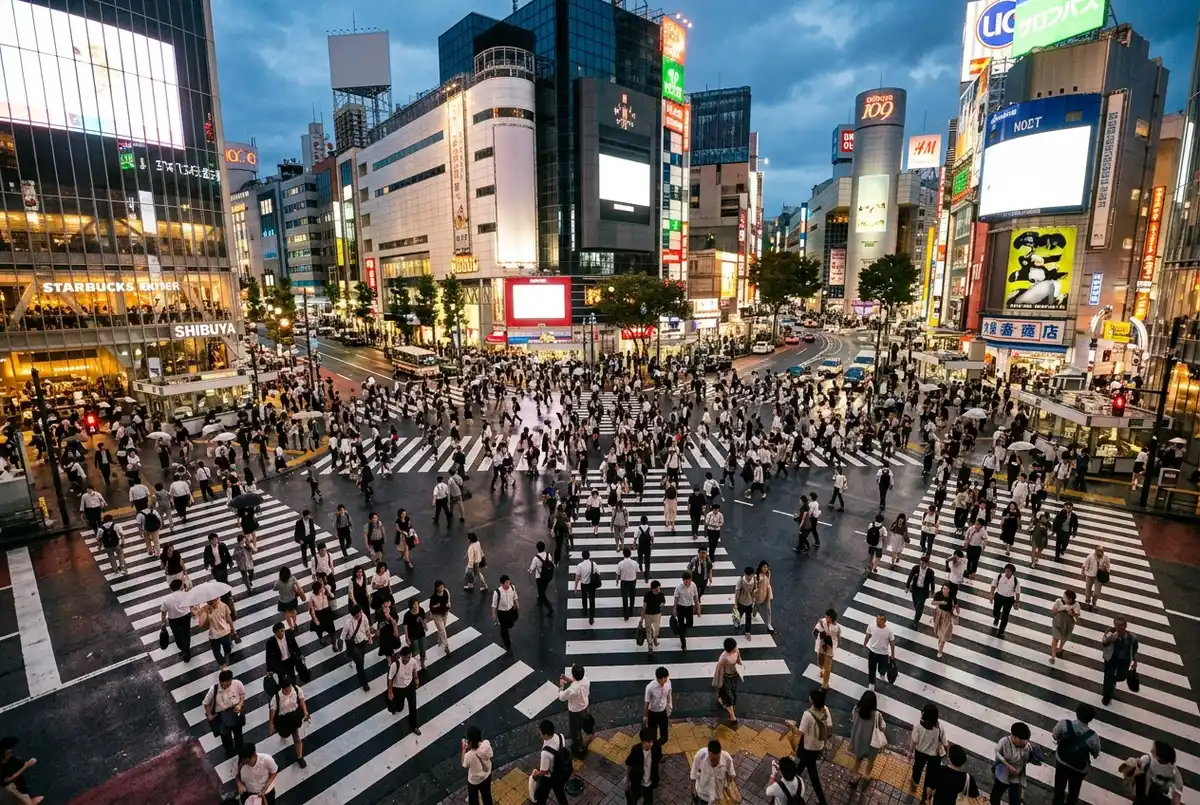
What is Shibuya Crossing? It is a large pedestrian scramble intersection right outside Shibuya Station in Tokyo, where traffic stops in every direction and people walk across from all sides, and diagonally, at the same time. It is one of the most photographed street scenes in the world. Here is what I’d tell a friend: cross it once for the feel of it, then find a way to see the whole pattern from above, because that is where the crossing finally makes sense. If you are planning that view, my Shibuya Sky guide shows how the rooftop deck fits in, and this page covers the basics first.
What Is Shibuya Crossing, in Plain Words?
Shibuya Crossing is a busy junction where cars get a red light in every direction, and pedestrians get the whole intersection to themselves for a short time. Instead of waiting at four corners and walking straight, people flow across in a wide diagonal mix.
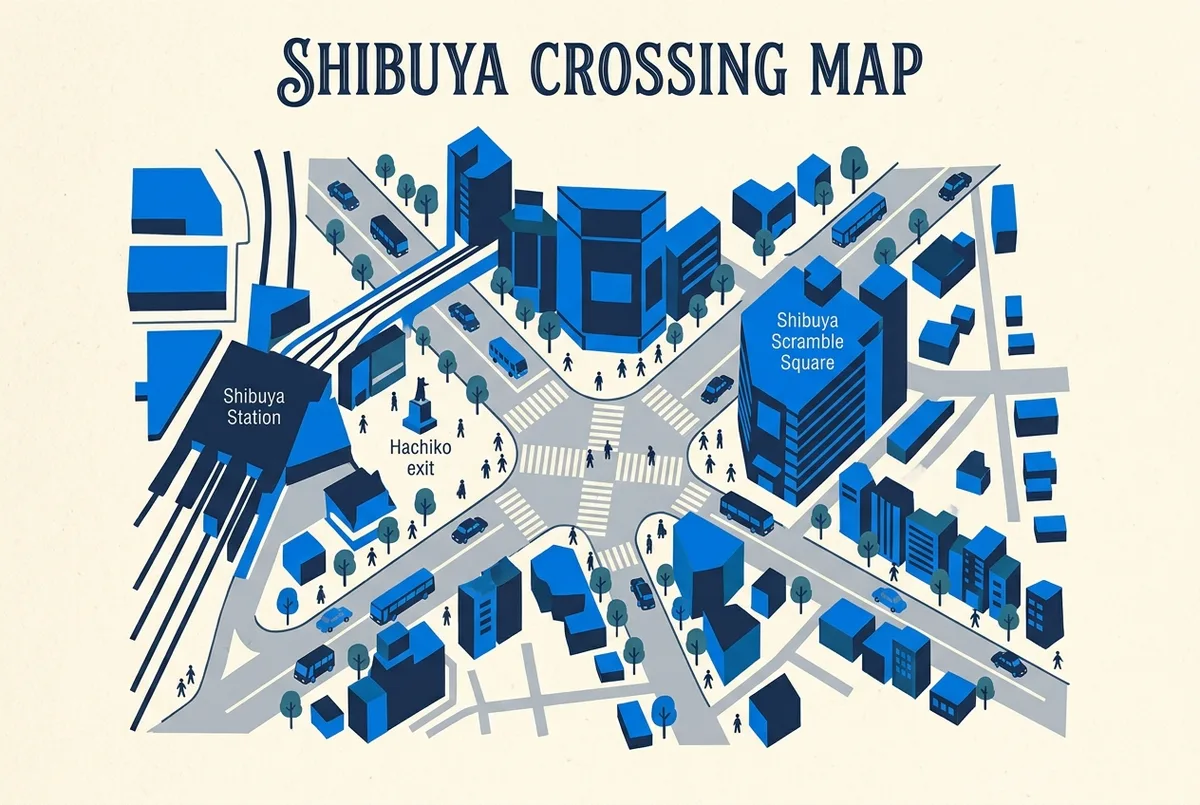
That design is called a scramble. Many cities have small ones, but Shibuya is the one people mean when they say “the scramble”. It sits in front of the Hachiko exit of Shibuya Station, and it is lined with tall buildings and video screens. For a neutral reference on the history and layout, the Shibuya Crossing page on Wikipedia is a good starting point. My view is simple: it looks like chaos and behaves like choreography, and that contrast is the whole appeal.
Check prices & dates
Ready to visit?
Book your tickets in advance: popular time slots sell out.
Shibuya Crossing is famous because of its scale, its setting and its screen time. Huge crowds cross together under neon signs, and the scene has appeared in films, music videos, games and travel photos for years, so many visitors arrive already knowing what it looks like.
I’d give three reasons it sticks in people’s minds. First, the sheer number of people crossing at once is unusual, and the movement looks almost organized. Second, the surroundings are pure Tokyo: giant screens, shopfronts, department stores and towers on every side. Third, it is free and easy to reach, so it became the default “I was in Tokyo” photo. Honestly, I think the fame is earned, but I would not build a whole day around it. It is a ten minute experience with a very long shadow.
How Many People Cross Shibuya Crossing per Day?
Nobody can give you one exact number, because counts change by day, season and event. Commonly cited figures say that at busy moments a very large crowd crosses in a single signal cycle, and that the daily total runs into the hundreds of thousands.
I’d treat those numbers as a sense of scale, not a fact to quote. Crowds are heaviest on weekend afternoons and evenings, after work on weekdays and around holidays or big events. They are lighter in the early morning. If you searched “shibuya crossing how many per day”, the honest answer is “a lot, and it varies”. What matters for your plan is the rhythm: signals cycle every couple of minutes, so you get repeated waves rather than one long stream, and that is what makes the view from above so good.
What Does Shibuya Crossing Look Like on Street View?
On a map service you can drop into street view and stand at the crossing from your desk. That is useful for orienting yourself, finding the Hachiko exit and seeing which buildings surround the junction. It does not show you the movement.
I’d use street view as a planning tool, not a substitute. It gives you a frozen moment with no crowd wave, no sound and no sense of the screens changing. The value is in checking the geography before you land, so you know where the station exit is, where the big corner buildings sit and where you might stand to watch. Imagery is also updated on the provider’s schedule, so some shops and signs may look different when you arrive. Treat it as a map with pictures.
What Shops and Buildings Are Around Shibuya Crossing?
The crossing is ringed by department stores, fashion shops, electronics stores, cafes and restaurants, plus the station complex and a tall tower with a rooftop deck. Most sit within a couple of minutes’ walk of the corners.
If you searched “shibuya crossing shops”, here is how I’d think about it. Fashion and youth culture shops fill the streets that fan out from the crossing. Department stores and station shopping give you food halls and everyday buys. Restaurants and cafes range from quick counters to sit-down meals. Hours differ by shop, so I keep specifics out and suggest checking each one. My pick is to browse for an hour after you have crossed, then eat before you go up to a viewpoint. For more ideas on how to fill a couple of hours, see things to do near Shibuya Sky.
Why Does the View From Above Matter?
The view from above matters because the crossing is a pattern, and you cannot see a pattern from inside it. At street level you see a wall of people and a lot of shoulders. From height, you see waves, diagonals and the way every signal cycle refills the junction.
This is the strongest argument for going up, and I’d make it without hesitation. A rooftop or high window turns a crowded walk into a moving picture. The tall tower right beside the crossing has an open-air deck at about 229 meters, and I explain the building in Shibuya Scramble Square. If your budget is tight, there are free vantage points, with honest limits, in my guide to the best free places to see Shibuya Crossing. For the full ranking of every option, start with the pillar, Shibuya crossing view.
When Is the Best Time to See Shibuya Crossing?
The best time depends on what you want. For the biggest crowds, go on a weekend afternoon or evening. For lights and screens, go after dark. For a calmer look and cleaner photos, go early in the morning.
My personal pick is dusk, because you get the blue sky, the first lit screens and a busy crowd all at once. I’d avoid midday in peak summer heat if you plan to stand around. If you want the night version in detail, read Shibuya Crossing at night. Rain changes the scene too: umbrellas make the crowd look like a moving carpet of color, which some people love.
How Do You Cross It Without Stress?
Wait for the signal, stay with the flow and keep your eyes up. The crowd moves on its own, and people generally avoid each other without needing any effort from you.
Here is my advice. Do not stop dead in the middle to take photos, because you will block the flow. Take your photos from the edge, or from above. Keep your bag in front of you as you would in any busy city area. And do it twice if you can: once in daylight and once at night, since the feeling is different. It takes only a couple of minutes each time, so it is easy to fit in without much planning.
What Is the Best Way to Combine the Crossing With a View?
The simplest combination is to cross first, walk the streets around it, then go up to a deck and watch the same scene from above. That order lets you understand what you are looking at when you reach the top.
If you would like a guide, a ticket and the key stops in one booking, the Shibuya Sky morning tour with ticket is a compact 2 hour option. Prices start from EUR 75 per person as of 2026-09-21 and may vary by date, group size and season. Food, drinks and transport to the meeting point are not included. I’d choose it for a first visit because the timing is handled for you and you go up while the air is often at its clearest. If you would rather plan on your own, my Shibuya one day itinerary lays out a full day, and is Shibuya in Tokyo explains where the district sits.
Common Mistakes First Time Visitors Make
The most common mistakes are expecting a long attraction, blocking the crossing for photos and never seeing it from above. Another is arriving at the wrong exit and walking in circles inside the station.
I’d add two more. Do not judge the crossing on one visit at a dull moment: a weekday morning and a Saturday night are different experiences. And do not assume the crowd figures you read online will match what you see. The scale is real, but it changes with the day. Plan for a short, memorable stop rather than a checklist item that takes half a day.
My Recommendation
Cross it once, look up, then go up. If you have only one hour in Shibuya, I’d spend ten minutes at street level and the rest on a good view. If you have a full day, I’d cross at dusk and again at night. Skip long queues for a photo at street level: the best picture of Shibuya Crossing is not taken from inside it.
What Is Shibuya Crossing? FAQ
What is Shibuya Crossing?
It is a pedestrian scramble intersection outside Shibuya Station in Tokyo, where all traffic stops and people cross from every direction at once.
Why is Shibuya Crossing famous?
It is famous for the scale of its crowds, the screens and neon around it, and its many appearances in films, games and travel media. It is also free and easy to reach.
How many people cross Shibuya Crossing per day?
There is no single exact figure. Commonly cited estimates run into the hundreds of thousands per day, with very large crowds at each busy signal cycle, but numbers vary by day and season.
Is Shibuya Crossing worth visiting?
Yes, as a short stop. I’d give it ten to twenty minutes at street level and then add a view from above for the full effect.
Are there shops near Shibuya Crossing?
Yes. Department stores, fashion shops, cafes and restaurants surround the junction and the station, all within a few minutes on foot. Check each shop for its own opening hours.