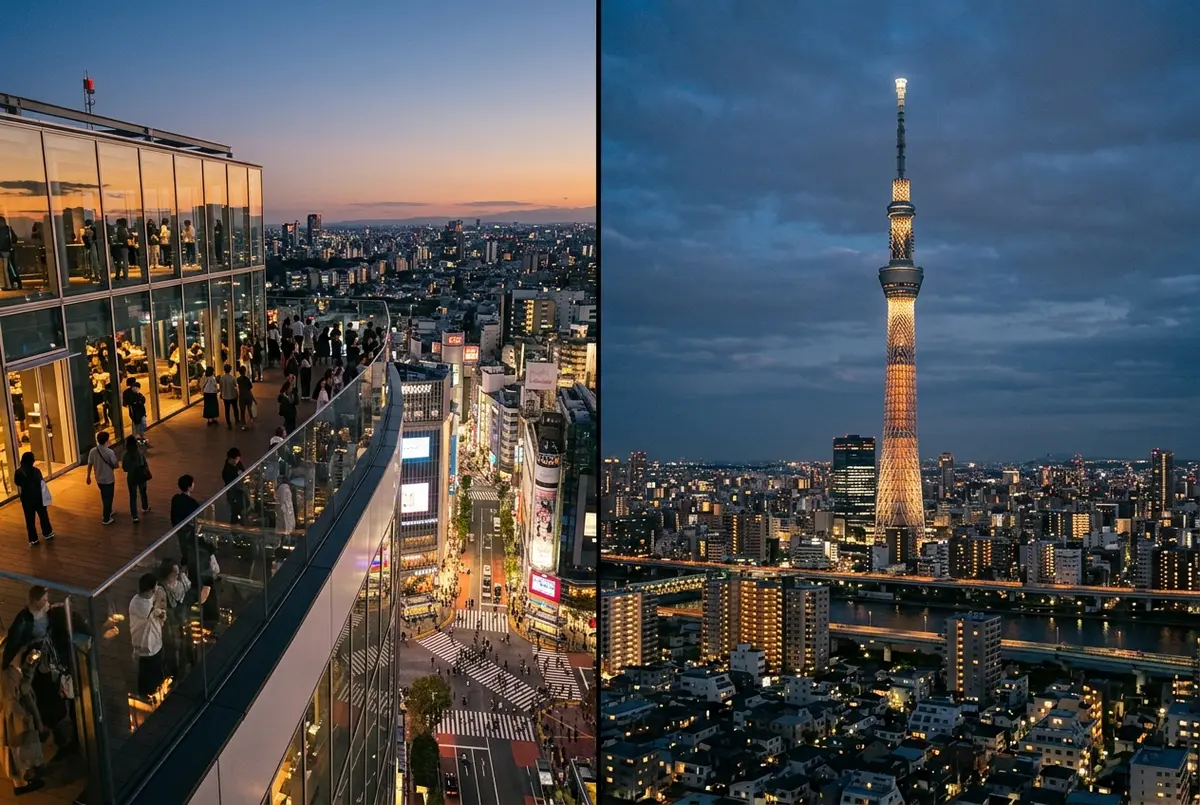
Shibuya Sky vs Tokyo Skytree: Which Should You Visit
See prices From 86 EUR · Free cancellation available
Contents
Shibuya Sky vs Tokyo Skytree is a real choice, but the first thing to know is that they are not the same place, and there is no “Shibuya Skytree” or “Shibuya Sky Tree”. Shibuya Sky is an open-air rooftop deck in the Shibuya Scramble Square building, right above the famous crossing. Tokyo Skytree is a very tall broadcast tower in the east of the city, with enclosed observation decks. Here is what I’d actually do: choose Shibuya Sky if you want an open-air, city-center, sunset-and-lights experience, and choose Skytree if raw height is your priority. This guide gives you the head-to-head table, the trade-offs and a clear verdict. For a full look at the Shibuya deck itself, read the Shibuya Sky observation deck guide, and if you are ready to look at slots and prices, the Shibuya Sky tickets guide explains how booking works. You can also start from the Shibuya Sky homepage for tours that include your deck ticket. Because guided packages differ in length, price per person and what is included, it helps to see which guided Shibuya Sky routes fit your trip and budget before you decide.
Are Shibuya Sky and Tokyo Skytree the Same Thing?
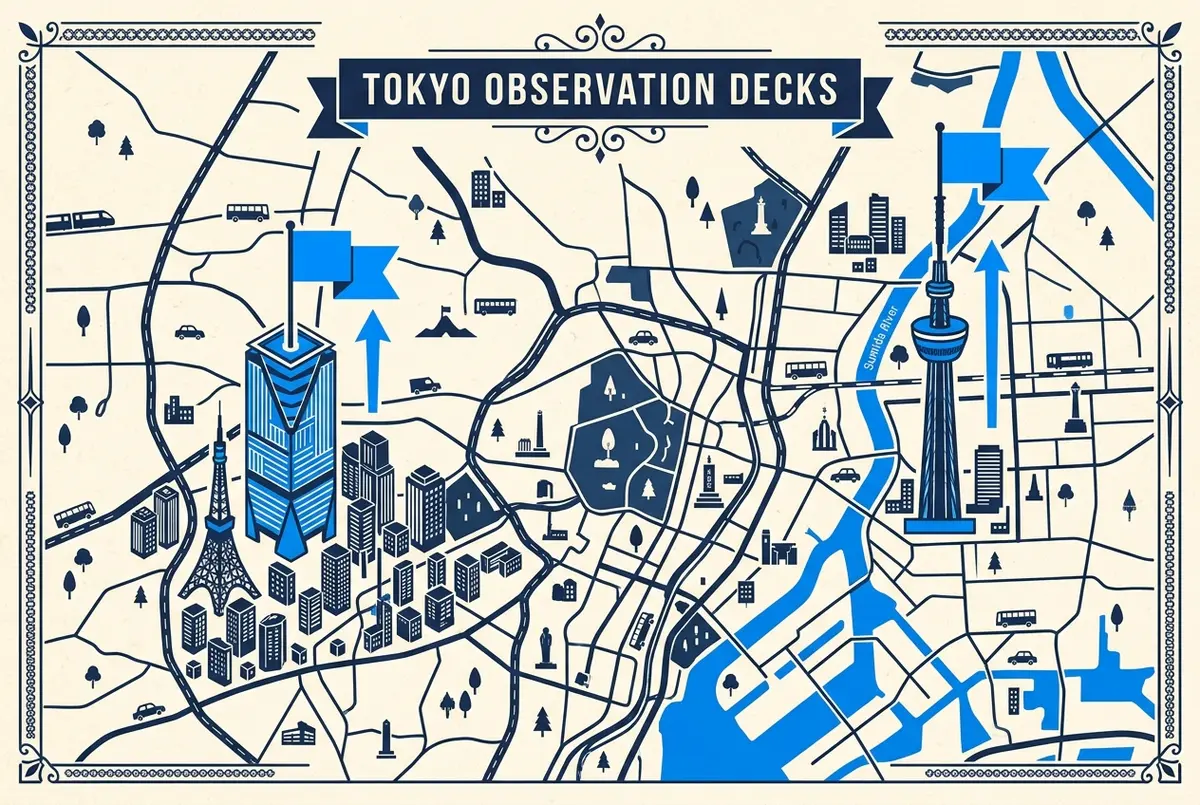
No. They are two separate attractions in two different parts of Tokyo, run by different operators. Shibuya Sky is in Shibuya, in the west of the city center. Tokyo Skytree is in Sumida, in the east. There is no combined “Shibuya Skytree”.
The mix-up is common because both names include “Sky”, both are famous observation points and both come up in the same searches. People type “shibuya skytree”, “shibuya sky tree” or “tokyo skytree vs shibuya sky” when they are really comparing two decks. That is a sensible comparison, and it just needs the two places kept apart.
Here is a simple way to remember it. Shibuya Sky is a rooftop on a building in a busy neighborhood, where the crossing is the star. Tokyo Skytree is a freestanding tower far taller than any building around it, where the height is the star. Different shapes, different views, different moods.
Check prices & dates
Ready to visit?
Book your tickets in advance: popular time slots sell out.
If you are landing on this page from a search for “is Tokyo Tower and Tokyo Skytree the same”, the answer is also no. Tokyo Tower is a third landmark, an older red-and-white tower. I compare it in Shibuya Sky vs Tokyo Tower: which view is better.
Shibuya Sky vs Tokyo Skytree: The Quick Comparison Table
Here is the head-to-head. Figures are approximate and well known, and you should confirm current details on each operator’s official page before you book.
Feature
Shibuya Sky
Tokyo Skytree
Location
Shibuya, west-central Tokyo
Sumida, east Tokyo
Building type
Rooftop deck on a skyscraper
Freestanding broadcast tower
Deck height
About 229 meters
Decks at roughly 350 and 450 meters, tower about 634 meters
View type
Open-air rooftop plus indoor gallery
Enclosed glass decks
Star of the view
The crossing below, the city skyline, sunset
Sheer height, the whole Kanto plain, Mt. Fuji on clear days
Best time
Sunset and early night
Clear days, and sunset or night
Crowds
Timed entry, busy at sunset and holidays
Busy at peaks, tiered tickets
Price
Varies by slot and age, check official
Tiered by deck and date, check official
Wind and weather
You feel it on the open deck
Sheltered inside
I have kept price as “varies, check official” on purpose. Admission prices change and depend on the date, the slot and the deck, so I would rather send you to the source than print a number that may be out of date. The one price I can state from our own data is for guided packages that include the Shibuya Sky ticket, which start from EUR 63 to EUR 105 per person for most routes as of 2026-09-21 and may vary.
Which Is Higher: Shibuya Sky or Tokyo Skytree?
Tokyo Skytree is far higher. The tower is about 634 meters tall, and its observation decks sit at roughly 350 and 450 meters. Shibuya Sky is about 229 meters up. Skytree wins the height contest by a wide margin.
But height is not the same as a better view. A much higher deck gives you a wider, flatter, more abstract picture of the city. You see the whole sprawl and, on a clear day, far-off mountains. A lower deck, closer to the streets, lets you see people, roads, lights and the crossing itself. For many visitors that is the more exciting picture.
My view is that 229 meters is the sweet spot for feeling connected to the city, and 350 meters and up is the sweet spot for feeling how big it is. If you want to check the figures and see what you can spot at that altitude, our page on Shibuya Sky height and floors: how high is the deck covers it.
What Is the View Like from Each Deck?
From Shibuya Sky you look out over a dense, glowing core of the city, with the crossing directly below and Tokyo Tower in the distance on a clear evening. From Skytree you look over a huge, sprawling plain, with rivers, low-rise neighborhoods and far-off horizons.
The difference is texture. Shibuya’s view is busy and dramatic, especially at dusk. Skytree’s view is vast and calm, especially on a clear morning. Neither is better in an absolute sense. It depends on the feeling you are chasing.
The open-air stage at Shibuya Sky is also a big part of the appeal. You stand outside with no glass between you and the city, and you feel the wind. Skytree’s decks are enclosed, so you are behind glass, which is more comfortable in cold or wet weather but less immersive and, for photos, can mean reflections.
Shibuya Sky is my pick for sunset, because the open-air stage lets you watch the colors move across the skyline with no glass in the way. Then the city lights come on beneath you. The whole sequence takes place at one spot.
Skytree also does sunset well, and the height gives a long, wide sunset horizon. It can feel more like watching the sun sink into the whole plain. But most travelers want the “city coming alive” feeling, and that belongs to Shibuya.
For a lit-city mood, I’d choose Shibuya Sky. The skyline glitters, the crossing pulses and the open air adds atmosphere. Skytree at night is also beautiful, with a huge field of lights below, but it feels calmer and more distant.
If you like the idea of a neon evening, the Shibuya area suits it. The streets around the station are lively, and you can walk in for food and drinks after your slot. Skytree sits in a quieter district, so your evening options after the deck are different.
For a first trip, I’d choose Shibuya Sky. It sits in the center of the classic Tokyo itinerary, near Harajuku, Shinjuku and the crossing, and it is easy to fit into a day of sightseeing. Skytree is a bigger detour.
Location matters more than people expect. If you are staying on the west side, a trip to Skytree means a long rail ride each way. If you are staying near the east side, Skytree can be a quick add-on. Look at your hotel and your route, not just the deck.
That said, Skytree is a genuine icon, and if you have time, both can fit into a longer trip. I’d never tell a first-timer to skip it, only to rank it after the deck that fits their route.
Which Is Better for Families with Kids?
Skytree is often easier for young children because the decks are enclosed and sheltered, and the surrounding complex has shops and other things to do. Shibuya Sky is fine for kids who enjoy the open air, but wind and height can worry small ones.
I would say it depends on your child. A calm, curious six-year-old will love the open stage. A nervous toddler may prefer the indoor part. For rules on ages, strollers and tips, see Shibuya Sky with kids: age rules, strollers and tips.
If your family is in Tokyo for several days, I’d treat one of them as the main deck and skip the other, unless everyone loves views.
How Do Crowds and Booking Compare?
Both attractions are popular, and both are busiest at sunset, on weekends and in holiday periods. Shibuya Sky uses timed entry, so slots can sell out, especially at sunset. Skytree has tiered tickets and its own queue system.
The safest habit for either one is to book ahead and choose a slot you can move. If you plan to go at a peak time, read Shibuya Sky reservation: how far ahead should you book for the logic, and the official page for the latest rules.
I would not plan on walk-ups at sunset for either deck. It is a gamble, and the price of losing is a wasted trip across the city.
How Do Prices Compare?
Prices vary for both decks, and I would not quote an admission fee from memory. Skytree has tiered pricing that depends on which deck you choose and when. Shibuya Sky prices depend on the slot, the date and the age of the visitor.
The best way to compare is to look at the official pages side by side for your date. Then add the cost of getting there. If you are already in Shibuya, the deck costs you almost no extra travel. If you are in the west of the city, Skytree adds fares and time.
Yes for the right person. If you want the highest view in the city, love big-scale panoramas or want the best chance at a huge Mt. Fuji horizon, it is worth it. If your priority is the city buzz and an open-air rooftop, Shibuya Sky is a better match.
Tokyo Tower is a third choice, an older, lower tower closer to the center that is itself part of the skyline. The famous trick is that Tokyo Tower is a landmark you look at, and it appears in the view from Shibuya Sky, while Skytree is a landmark you look from.
Tokyo has good free and cheaper viewpoints too. The Metropolitan Government Building has a free-entry deck, and other decks such as the one in Roppongi offer a different angle. They are worth knowing about, because a paid deck is not always the right pick.
Pick by what you want, where you are staying and when you will go. Do not pick by fame alone. Here is the checklist I’d use:
Want an open-air rooftop? Shibuya Sky.
Want the highest possible view? Tokyo Skytree.
Staying west or central? Shibuya Sky is easier to reach.
Staying east? Skytree is convenient.
Want sunset with the crossing below? Shibuya Sky.
Traveling with a nervous small child or in bad weather? Skytree’s enclosed decks may be gentler.
On a tight budget? Compare the current prices, and consider a free deck.
If two or three answers point to Shibuya Sky, book it. If they split evenly, do the deck nearer your hotel and save the other for a return trip.
Can a Guided Tour Help You Choose?
A guided package can simplify the choice, because it bundles your Shibuya Sky admission with a guided walk and timing. It is a good fit if you want context and do not want to plan every step.
The Shibuya Sky night view tour with ticket is a 2 hour evening with about 45 minutes on the deck, followed by the neon crossing and Miyashita Park’s Yokocho. Prices start from EUR 86 per person as of 2026-09-21 and may vary by date, group size and season. Food, drinks and transport to the meeting point are not included.
I like it as a first-night choice because it delivers the lights, the crossing and a dinner suggestion in one go. If you would rather go on your own, a plain ticket gives you flexibility, and the Shibuya Sky tickets page explains the options.
Common Mistakes When Comparing the Two
The biggest mistakes are assuming the two are the same, judging only on height and forgetting the travel time between them. Another is booking a sunset slot without checking the real sunset time for your date.
I would add one more: expecting a guarantee. Views depend on the weather. Both decks can be hazy, and any promise of Fuji on a given day is just a hope. Read the terms on your booking, and give yourself a spare day. If a flexible date is part of your plan, see Shibuya Sky ticket cancellation and refund: what to expect.
My Recommendation
Choose Shibuya Sky if it is your first time in Tokyo, if you are staying in the west or center, and if you want an open-air rooftop at sunset with the crossing below you. Choose Tokyo Skytree if you want the tallest view in the city and you are happy to travel east for it. If you only have time for one, I’d pick Shibuya Sky for most travelers, because it is easier to fit into a classic itinerary and the open-air stage is hard to match.
Book a sunset or early night slot, keep your date flexible and check the official pages for the latest rules and prices. When you are ready, book your Shibuya Sky ticket and lock in the slot before it sells out.
No. Shibuya Sky is an open-air rooftop deck in Shibuya. Tokyo Skytree is a tall tower in Sumida. There is no place called Shibuya Skytree.
Which is better, Shibuya Sky or Tokyo Skytree?
It depends on your goal. Shibuya Sky is better for an open-air rooftop, sunset and the crossing below. Skytree is better for raw height.
Which is higher, Shibuya Sky or Tokyo Skytree?
Tokyo Skytree is much higher. The tower is about 634 meters, with decks at roughly 350 and 450 meters, while Shibuya Sky is about 229 meters.
What is the difference between Shibuya Sky and Tokyo Skytree?
Shibuya Sky is an open-air rooftop in the city center, with the crossing below. Skytree is a freestanding tower with enclosed decks and a vast, high view.
Can I visit both in one trip?
Yes, if you have time. They are in different parts of the city, so I’d plan them on separate days or at least separate halves of a day.